
Last updated 08-21-2026
Category:
Reviews:
Join thousands of AI enthusiasts in the World of AI!
Mindgard
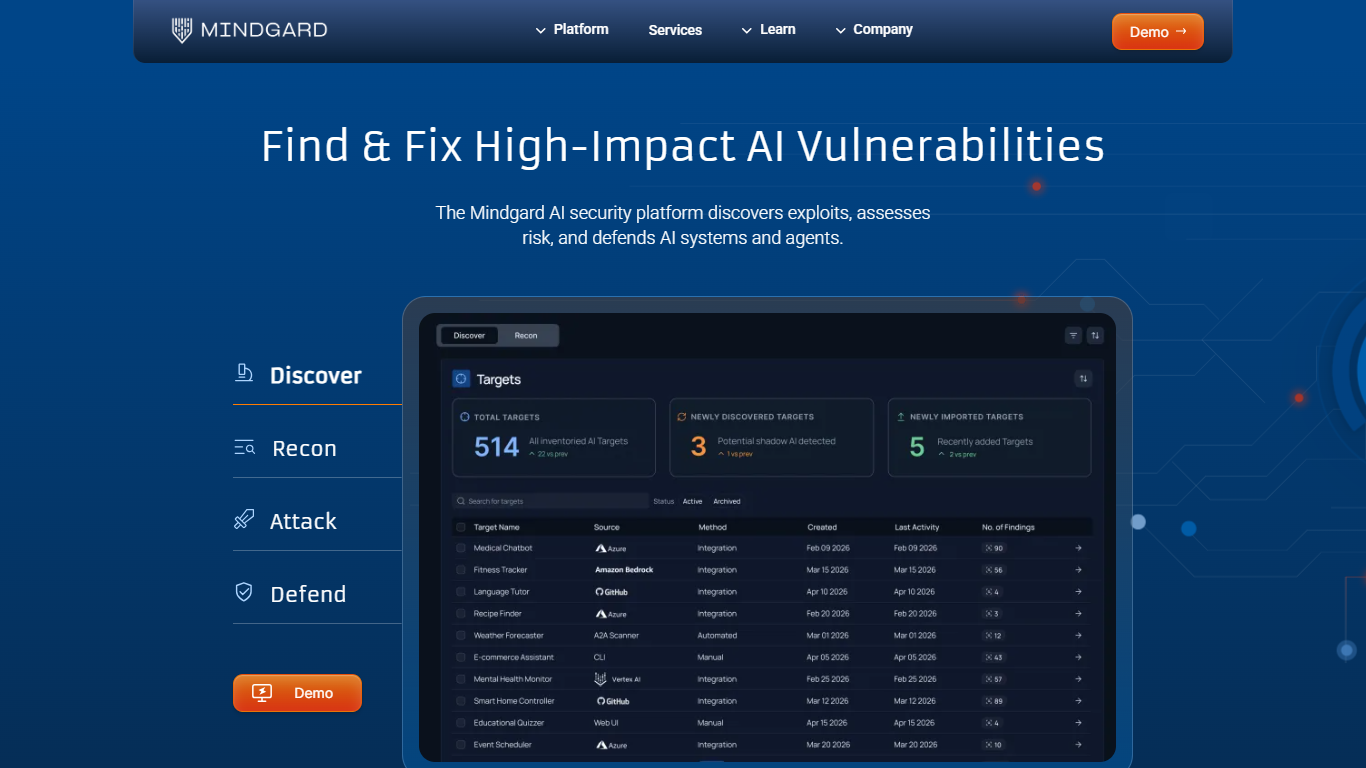
Mindgard gives security and engineering teams an automated red-teaming platform for production AI systems, chatbots, agents, and the infrastructure around them. It maps models, prompts, tools, and data flows, runs attacker-style reconnaissance, and surfaces exploitable flaws before adversaries do. Public write-ups on the site cover findings in systems such as Google Antigravity, OpenAI Sora, Zed IDE, and xAI Grok.
Generic application scanners treat AI as another web app. Mindgard profiles agents the way offensive researchers do, chaining cross-modal prompts, guardrail busting, and agent-native recon to find higher-impact paths than broad prompt spam. Its knowledge base draws on 150 plus disclosed AI vulnerabilities, and the company roots the product in more than a decade of Lancaster University research.
CISOs, ML platform owners, and AppSec teams shipping copilots or agent workflows integrate Mindgard through CI/CD, Burp Suite, or one-click scans when they need continuous discovery, red teaming, and runtime defense without hiring a dedicated AI security lab.
Maps AI attack surfaces across models, agents, tools, and application data flows
Knowledge base informed by 150 plus publicly disclosed AI vulnerabilities on the homepage
Automated AI red teaming with agent profiling and guardrail-busting reconnaissance
Runtime AI protection and automated agent hardening in the Defend module
Deploys through CI/CD pipelines, Burp Suite, or one-click assessments
Founded in 2022 with about $11.9M raised and 24 employees per company entity data
Purpose-built for LLM, agent, and multimodal attack paths
Research-backed vulnerability library beyond generic OWASP checks
CI/CD and Burp integrations fit existing AppSec workflows
Public case studies on major AI products build credibility
Covers discovery through runtime defense in one platform
Enterprise-focused with no self-serve pricing on the public site
Requires security team ownership to act on findings
Deep agent testing may need staging environments
Less relevant for teams not yet shipping AI to production
What does Mindgard secure?
Mindgard secures AI chatbots, applications, agentic workflows, and supporting infrastructure. It discovers shadow AI, builds AI-BOM inventories, and tests how attackers could exploit models, prompts, and connected tools.
How is Mindgard different from regular penetration testing?
Mindgard uses agent-native reconnaissance and AI-specific attack libraries rather than generic web scans. It profiles behaviors, chains cross-modal prompts, and prioritizes exploitable AI risk over noisy prompt failures.
Can Mindgard integrate with CI/CD?
Yes. Mindgard deploys through CI/CD, Burp Suite, and enterprise AI workflows according to its platform pages. Teams can run assessments in minutes without in-house AI security PhDs.
What vulnerabilities has Mindgard disclosed?
Mindgard publishes research on flaws in systems such as Google Antigravity, OpenAI Sora, Zed IDE, and xAI Grok. The homepage cites 150 plus AI vulnerabilities identified across leading AI products.
Does Mindgard offer runtime protection?
Yes. Mindgard's Defend module includes runtime AI protection, automated agent hardening, and defense audits. It complements Discover, Recon, and Attack stages in the same platform.
Who founded Mindgard?
Mindgard spun out of Lancaster University AI security research spanning more than ten years. Company entity data lists a 2022 founding year and United States headquarters.