
Last updated 08-22-2026
Category:
Reviews:
Join thousands of AI enthusiasts in the World of AI!
Ray
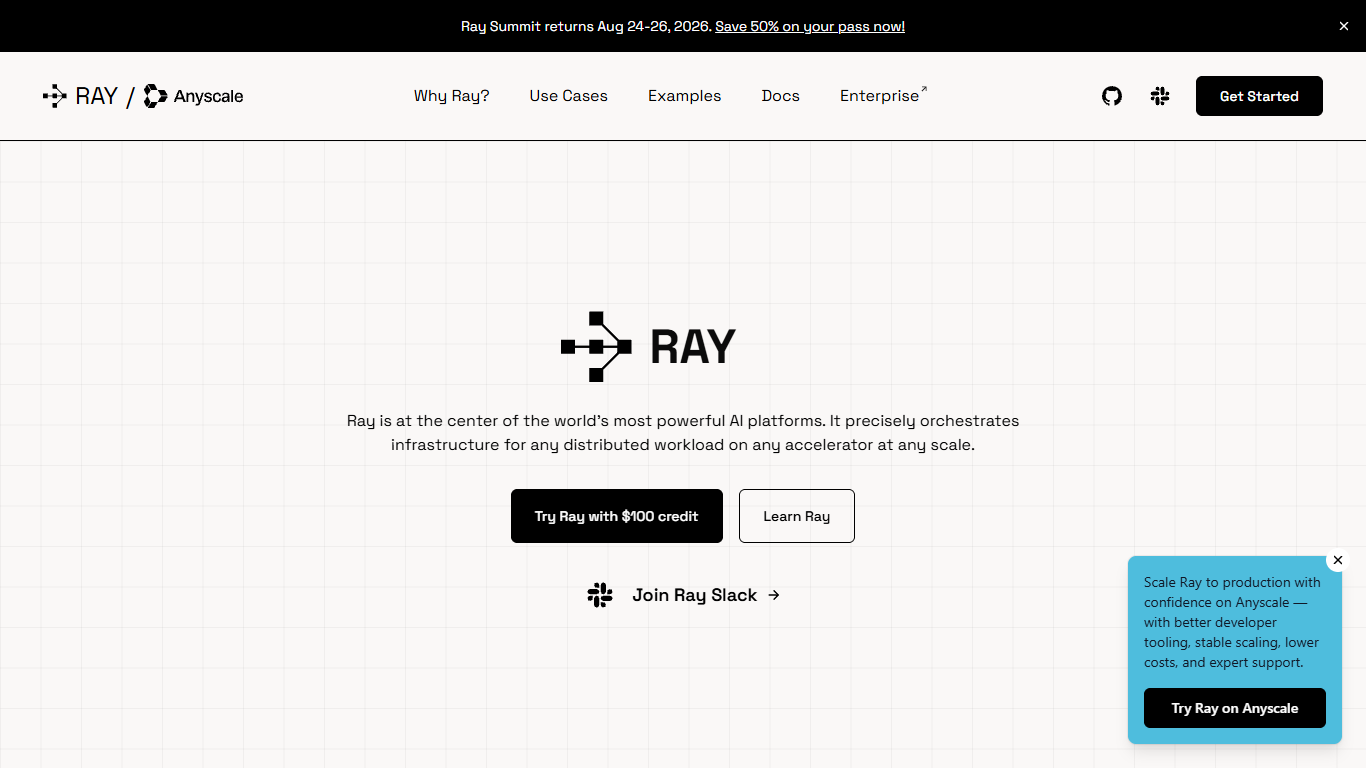
Ray is an open source AI compute engine for running distributed Python workloads across CPUs and GPUs. It orchestrates training, inference, data processing, and reinforcement learning so teams can move from a laptop prototype to production clusters without rewriting their code. The project is maintained by Anyscale and powers large-scale AI platforms used in production today.
Ray is Python-native and built around a small set of primitives: tasks, actors, and objects. That design lets you distribute ordinary Python functions and classes instead of learning a separate cluster API. High-level libraries sit on top for data loading, hyperparameter tuning, model training, serving, and RL workflows.
The framework targets ML engineers, data scientists, and platform teams who need fine-grained scaling across heterogeneous hardware. Ray supports multimodal data, foundation model training, batch and online LLM inference, GenAI pipelines, and classic ML models through libraries like Ray Data, Train, Serve, Tune, and RLlib.
Scale Python code from a laptop to thousands of GPUs
Ray Data handles images, video, audio, and structured datasets
Distributed foundation model training with one line of code
Ray Serve scales models independently with fractional GPU resources
Batch and online LLM inference on mixed CPU and GPU pipelines
Ray RLlib runs production reinforcement learning workloads
Open source framework with 34.8k GitHub stars and 1,000+ contributors listed on ray.io.
Covers the full ML lifecycle through Ray Data, Train, Tune, Serve, and RLlib libraries.
Scales from local development to large GPU clusters with Python-native APIs.
Supports heterogeneous CPU and GPU clusters with independent scaling per workload.
Managed hosting and enterprise features live on Anyscale, not on ray.io itself.
Most documentation and deep setup guides sit on docs.ray.io rather than the marketing site.
Distributed systems expertise is still needed for production cluster operations beyond local development.
Is Ray free to use?
Yes. Ray is open source software you can install and run on your own infrastructure at no cost. The core framework, libraries, and documentation on docs.ray.io are all available without a subscription.
What AI workloads does Ray support?
Ray supports parallel Python code, multimodal data processing, distributed model training, online and batch model serving, batch inference, reinforcement learning, GenAI workflows, LLM inference, and LLM fine-tuning. The homepage lists use cases spanning simulation, backtesting, RAG applications, and foundation model training.
What libraries are included with Ray?
Ray ships with Ray Core plus high-level libraries: Ray Data for data processing, Ray Train for distributed training, Ray Tune for hyperparameter search, Ray Serve for model deployment, and Ray RLlib for reinforcement learning. Documentation and product pages on ray.io also reference Ray LLM for large language model workloads.
What programming language does Ray use?
Ray is Python-native. You write standard Python functions and classes, and Ray distributes them across a cluster. The site describes Ray as built by developers for developers who want to scale existing Python code without adopting a new language or framework-specific cluster layer.
How do I get help or join the Ray community?
Ray maintains a community Slack workspace, discussion forums at discuss.ray.io, a GitHub repository at github.com/ray-project/ray, and an X account at @raydistributed. Ray.io also points to Anyscale training courses and documentation at docs.ray.io for hands-on learning.
Can Ray use different GPUs and CPUs in the same workload?
Yes. Ray is designed for heterogeneous compute. The site highlights independent scaling across mixed GPUs and CPUs, fractional resource allocation, and pipelines that combine CPU preprocessing with GPU inference to improve utilization and lower batch inference costs.