
Last updated 07-27-2026
Category:
Reviews:
Join thousands of AI enthusiasts in the World of AI!
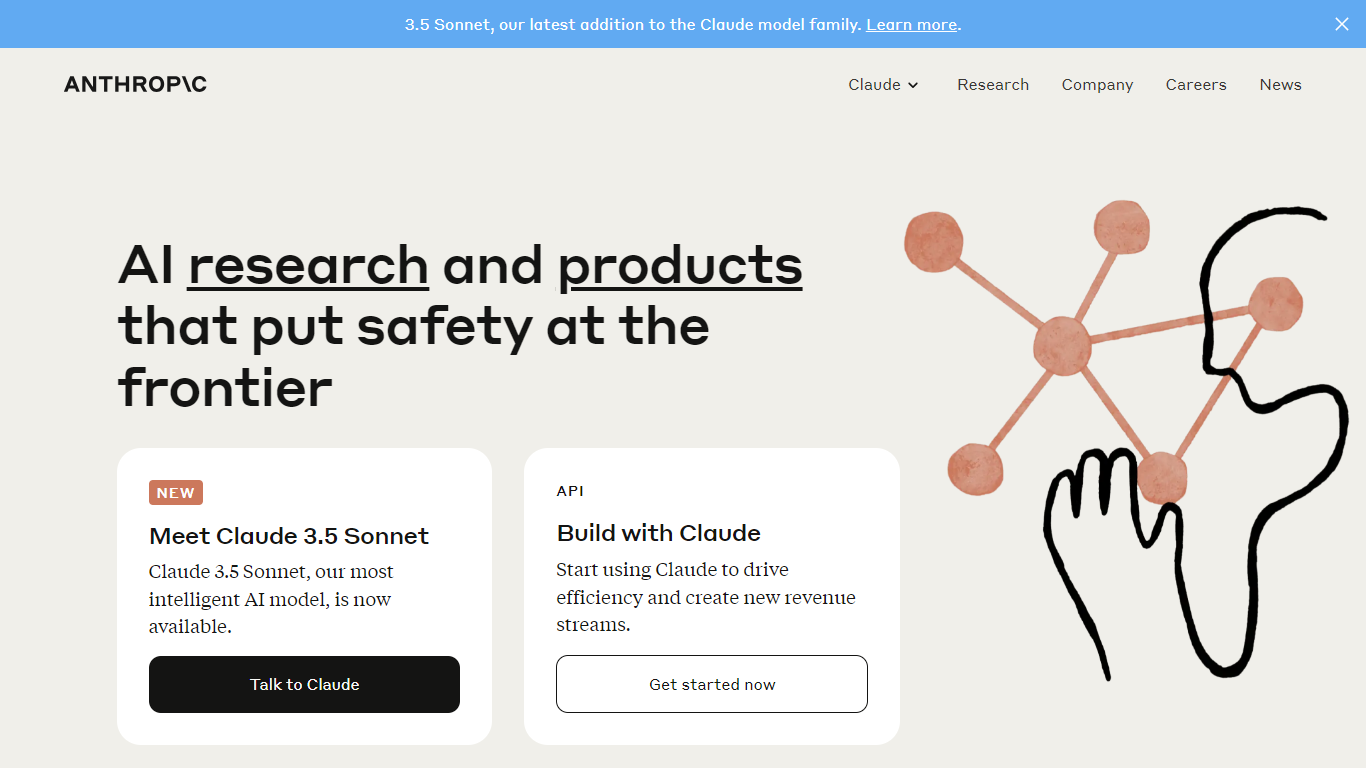
Anthropic
Anthropic develops AI systems designed to be reliable, interpretable, and steerable, focusing on safety and user control. Their AI models, including Claude Opus 5 and Claude Sonnet 5, offer advanced capabilities in coding, reasoning, and agentic tasks while maintaining rigorous safety standards.
What sets Anthropic apart is its commitment to AI safety as a systematic science, combining empirical research with practical deployment. Their Claude Science platform integrates common scientific tools and manages compute resources to support reproducible and auditable research workflows.
Anthropic provides broad accessibility through APIs and platform access across many countries, with compliance to regional regulations and cloud integrations. Their interdisciplinary team collaborates with civil society, government, and academia to promote safe AI development industry-wide.
The company supports diverse applications such as AI agents, code modernization, customer support, cybersecurity, healthcare, education, legal, and financial services. Anthropic balances innovation with ethical considerations to advance trustworthy AI systems for long-term human benefit.
🛡️ Advanced Safety Measures: Implements rigorous safeguards including real-time cyber classifiers and refusal of unsafe requests to ensure reliable AI behavior.
🤖 Agentic AI Models: Supports multi-step reasoning, tool use, and autonomous task completion for complex workflows with models like Claude Sonnet 5.
💻 Coding Excellence: Claude Opus 5 delivers state-of-the-art performance in software engineering, debugging, and code review at a lower cost.
🔬 Scientific Workbench: Claude Science integrates common research tools and databases for reproducible, auditable scientific analysis and manages compute resources.
🌍 Broad Accessibility: Offers API and platform access across many countries with compliance to regional regulations and integrations with AWS, Google Cloud, and Microsoft Foundry.
Strong focus on AI safety and interpretability
Offers advanced AI models optimized for coding and professional tasks
Provides a specialized AI workbench for scientific research
Global availability with regional compliance and cloud partnerships
Active collaboration with policy and civil society for responsible AI
Some advanced features require paid plans or enterprise agreements
Cybersecurity capabilities are intentionally limited for safety
Token-based pricing may be complex for some users
What is Claude Opus 5 and how does it improve on previous models?
Claude Opus 5 is Anthropic's latest AI model offering improved coding, reasoning, and professional work capabilities at a lower cost, with enhanced safety features compared to its predecessors.
How does Claude Science support scientific research?
Claude Science by Anthropic integrates common scientific tools and databases into a single environment, enabling researchers to perform reproducible analyses, manage compute resources, and generate auditable scientific artifacts.
What safety measures does Anthropic implement in its AI models?
Anthropic applies rigorous safeguards including real-time cyber classifiers, refusal of unsafe requests, and continuous safety evaluations to ensure Claude AI systems behave reliably and ethically.
Which regions have access to Anthropic's API and Claude.ai?
Anthropic offers commercial API and Claude.ai access in a wide range of countries across North America, Europe, Asia, Africa, and Oceania, with compliance to regional regulations.
Can developers integrate Anthropic's AI models into their own applications?
Yes, Anthropic provides APIs, developer documentation, and platform tools that allow integration of Claude models into various applications and workflows.
What industries and use cases does Anthropic support?
Anthropic supports diverse sectors including software development, healthcare, education, legal, financial services, customer support, and scientific research with tailored Claude AI solutions.
How does Anthropic approach AI safety research?
Anthropic treats AI safety as a systematic science, combining empirical research, interpretability, and policy engagement to build trustworthy Claude AI systems and share insights with the community.