
Last updated 07-29-2026
Category:
Reviews:
Join thousands of AI enthusiasts in the World of AI!
Blueprints
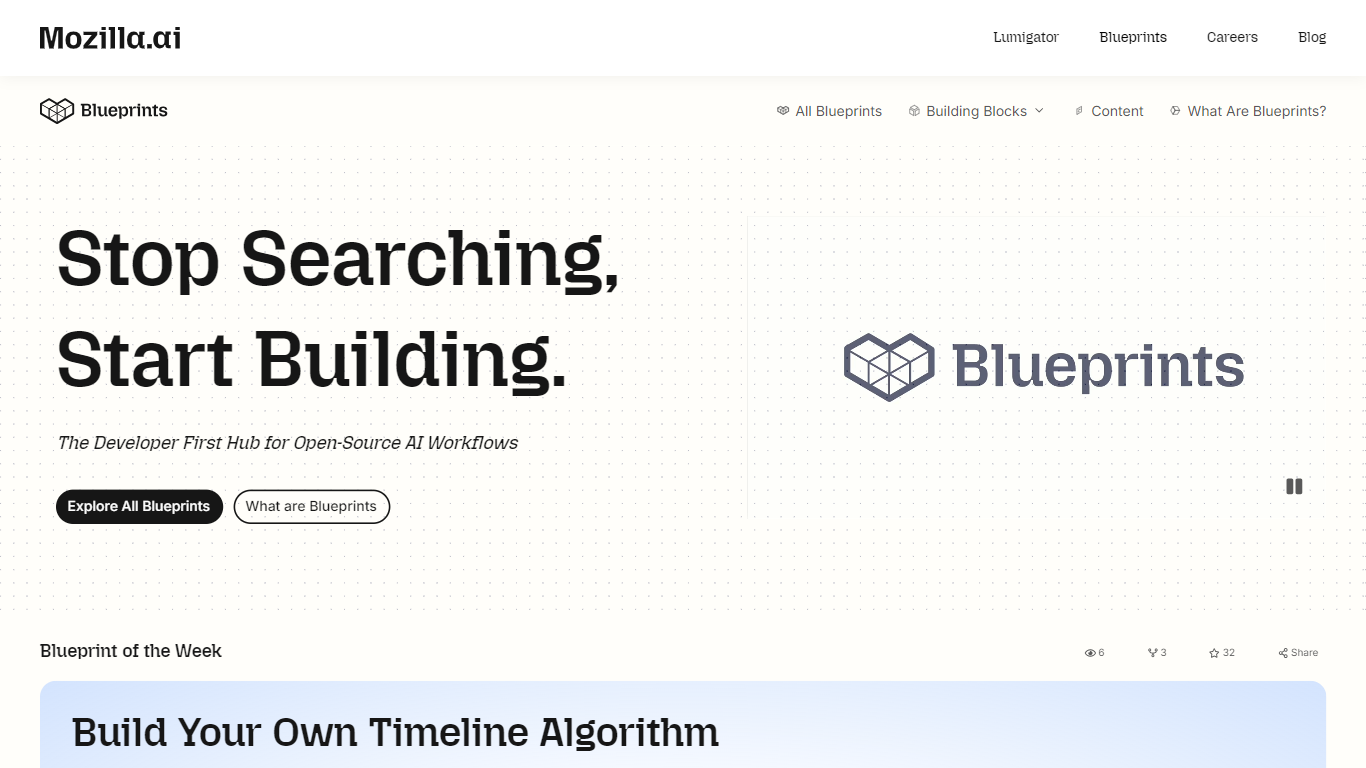
Blueprints is a developer-first hub for open-source AI workflows that helps developers build AI applications easily and flexibly. It offers ready-to-use, extendable workflows called Blueprints, each designed to solve specific AI problems with open-source tools and models. The platform emphasizes interoperability, making it simpler to integrate various open-source components without relying on closed-source APIs.
The target audience includes developers new to AI, researchers, and businesses looking for practical, customizable AI solutions. Blueprints supports community-driven development, encouraging users to fork, improve, and extend workflows, ensuring they stay relevant and up to date.
Blueprints prioritize privacy and collaboration through federated AI, allowing fine-tuning of models like large language models (LLMs) and object detection models on private datasets without sharing raw data. The platform also features a variety of Blueprints such as AI agents running in browsers via WebAssembly, speech-to-text alignment, document parsing, and synthetic audio detection.
Technically, Blueprints leverage open-source tools like Flower for federated learning, Streamlit and Gradio for interactive demos, Pyodide for running Python in browsers, and WebAssembly for high-performance browser-based AI agents. The platform provides detailed guidance, config files, CLI support, and demo apps to facilitate easy customization and deployment.
Blueprints maintain a consistent structure and quality by using a common template and adhere to open-source principles defined by the Open Source Initiative (OSI). They avoid recommending paid tools to keep solutions accessible. The platform also hosts events and resources to support learning and community engagement.
🚀 Ready-to-use AI workflows to jumpstart projects quickly
🔧 Easily customize Blueprints to fit specific AI needs
🤝 Collaborate on private data using federated learning
🧩 Integrate diverse open-source tools and models seamlessly
🌐 Run AI agents directly in browsers with WebAssembly support
Offers practical, tested AI workflows for developers new to AI
Supports federated learning to protect data privacy
Community-driven with active contributions and extensions
Enables running AI agents in browsers without extra installs
Uses only open-source tools ensuring transparency and accessibility
Requires some technical knowledge to customize and deploy
Limited to open-source tools, may lack some commercial features
How do Blueprints help developers new to AI?
Blueprints provide ready-to-use, customizable AI workflows that simplify building AI applications, reducing setup and troubleshooting time.
What makes Blueprints different from other AI platforms?
Blueprints focus on open-source tools, federated learning for privacy, and community-driven development, avoiding reliance on closed-source APIs.
Can I run AI agents directly in my browser with Blueprints?
Yes, Blueprints include WASM Agents that run AI agents in browsers using WebAssembly and Pyodide without extra installations.
How does Blueprints support data privacy?
Blueprints enable federated learning, allowing model fine-tuning on private datasets without sharing raw data, protecting user privacy.
Are Blueprints suitable for commercial use?
Yes, Blueprints are open-source and customizable, making them suitable for research, development, and business projects.
What technical tools does Blueprints use?
Blueprints use Flower for federated learning, Streamlit and Gradio for demos, Pyodide for browser Python, and WebAssembly for high-performance agents.
Is there community support for Blueprints?
Yes, Blueprints are community-driven with active contributions, extensions, and events to help users learn and collaborate.