
Last updated 07-26-2026
Category:
Reviews:
Join thousands of AI enthusiasts in the World of AI!
Lyzr
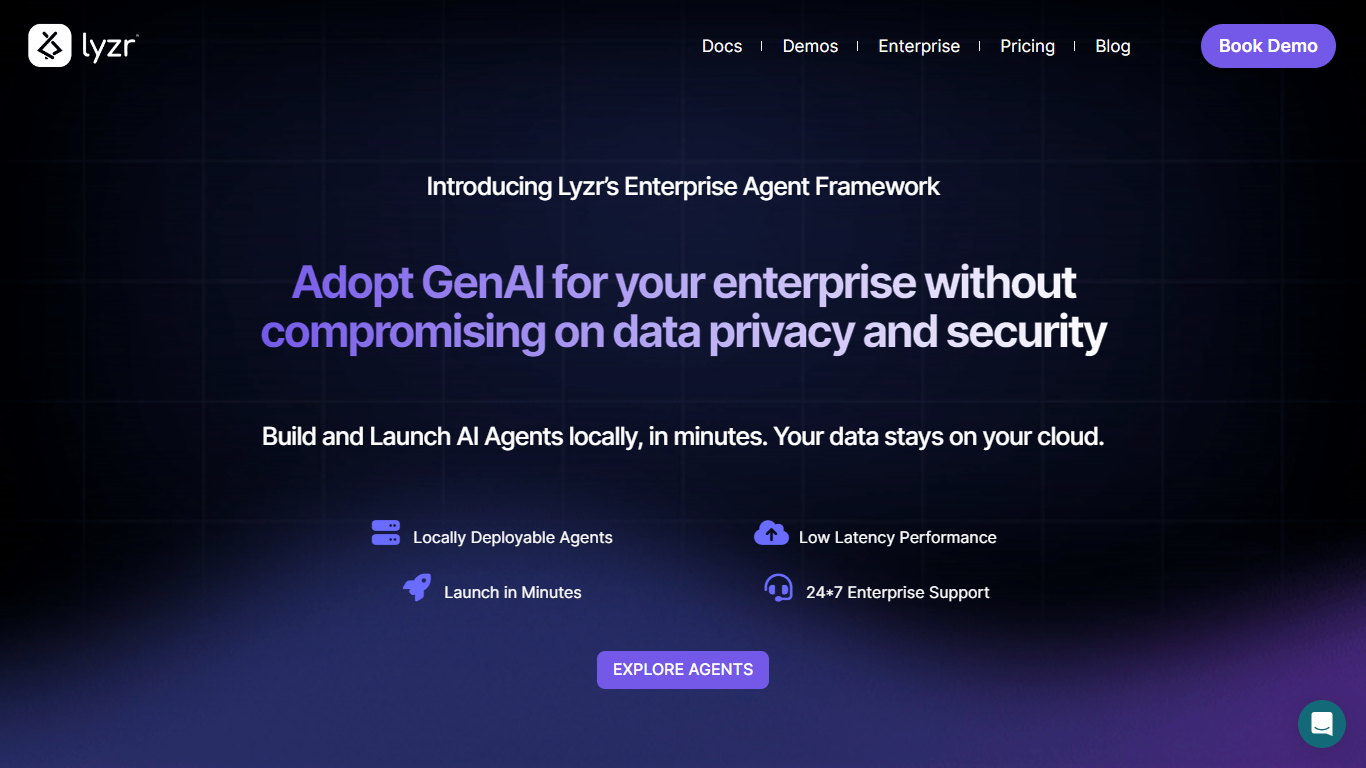
Lyzr takes AI agents from prototype to governed production on top of large language models. Agent Studio gives teams a visual workspace to design and deploy agents, while the Control Plane connects agents built on LangChain, Agentforce, AWS Bedrock, or custom stacks without forcing a migration. The stack covers design, build, simulation, deployment, observability, and compliance in one place.
Where most LLM agent builders stop at the prototype, Lyzr focuses on the production gap. Its Control Plane sits above whatever framework you already run, adding simulation, hallucination guards, PII masking, RBAC, and immutable audit logs in one layer. Lyzr claims 85% of agent projects reach production, versus an industry average it cites as under 30%, because simulation and governance are built in rather than bolted on later.
Enterprise teams in banking, insurance, healthcare, and HR use Lyzr to move agents from demo to governed production in weeks. Forward-deployed engineers can co-build the first agents, and 200+ pre-built agents across BFSI, sales, and operations give regulated teams a faster starting point. Customers include Accenture, Willis Towers Watson, Hitachi, and AirAsia Move.
Control Plane governs agents from LangChain, Agentforce, Bedrock, and custom stacks without migration
Usage pricing at $0.08 per agent run on Lyzr Cloud or $0.03 per run in your own VPC
Simulation Engine runs thousands of adversarial and domain-specific scenarios before deployment
Supports GPT-4o, Claude, Gemini, Llama, and Mistral with single-config model swaps
SOC 2 Type II, GDPR, HIPAA, and ISO 27001 compliance with SSO, RBAC, and immutable audit logs
200+ pre-built enterprise agents across banking, HR, sales, and customer support
Control Plane governs agents from any framework without forcing a stack migration.
Usage-based pricing with published per-run rates instead of opaque seat licenses.
Simulation Engine and hallucination guards catch failures before agents reach production.
SOC 2, GDPR, HIPAA, and ISO 27001 compliance with VPC and on-prem deployment options.
200+ pre-built agents and forward-deployed engineers shorten time to first production deployment.
No self-serve free tier; all plans require talking to sales for onboarding.
LLM token and compute costs are billed separately from the per-agent-run platform fee.
Enterprise focus means smaller teams may find the platform heavier than lightweight agent builders.
How much does Lyzr cost per agent run?
Lyzr charges $0.08 per agent run on Lyzr Cloud and $0.03 per agent run when deployed in your own VPC or on-prem. Each run bundles knowledge base calls, tool calls, memory, and responsible AI guardrails. LLM token costs are billed separately at pass-through usage rates.
What LLMs does Lyzr support?
Lyzr runs on GPT-4o, Claude, Gemini, Llama, and Mistral. The Control Plane sits above your model choice, so you can swap models with a single config change without rewriting agent logic. Cost comparison across LLMs is built into the platform.
Can Lyzr govern agents built on LangChain?
Yes. Lyzr Control Plane connects agents built on LangChain, CrewAI, AutoGen, Agentforce, and custom stacks without migration. It adds policy enforcement, observability, hallucination detection, and audit logging across every agent in your fleet from one console.
Is Lyzr SOC 2 compliant?
Lyzr is SOC 2 Type II certified along with GDPR, HIPAA, and ISO 27001 compliance. The platform includes SSO integration, role-based access at the agent and tool level, PII masking, and immutable timestamped audit logs exportable for regulatory review.
What is Lyzr Agent Studio?
Lyzr Agent Studio is the visual workspace for designing, building, testing, and deploying enterprise agents. It includes Architect for no-code agent creation, memory and RAG modules, tool integrations, and a Python SDK. Teams can also use pre-built agents and customize them for their environment.
How long does Lyzr take to reach production?
Lyzr reports an average of 4 weeks from build to production deployment, with 85% of agent projects reaching production. Forward-deployed engineers can co-build your first three agents. The Simulation Engine tests thousands of scenarios before any agent touches live traffic.