
Last updated 08-11-2026
Category:
Reviews:
Join thousands of AI enthusiasts in the World of AI!
Picsellia
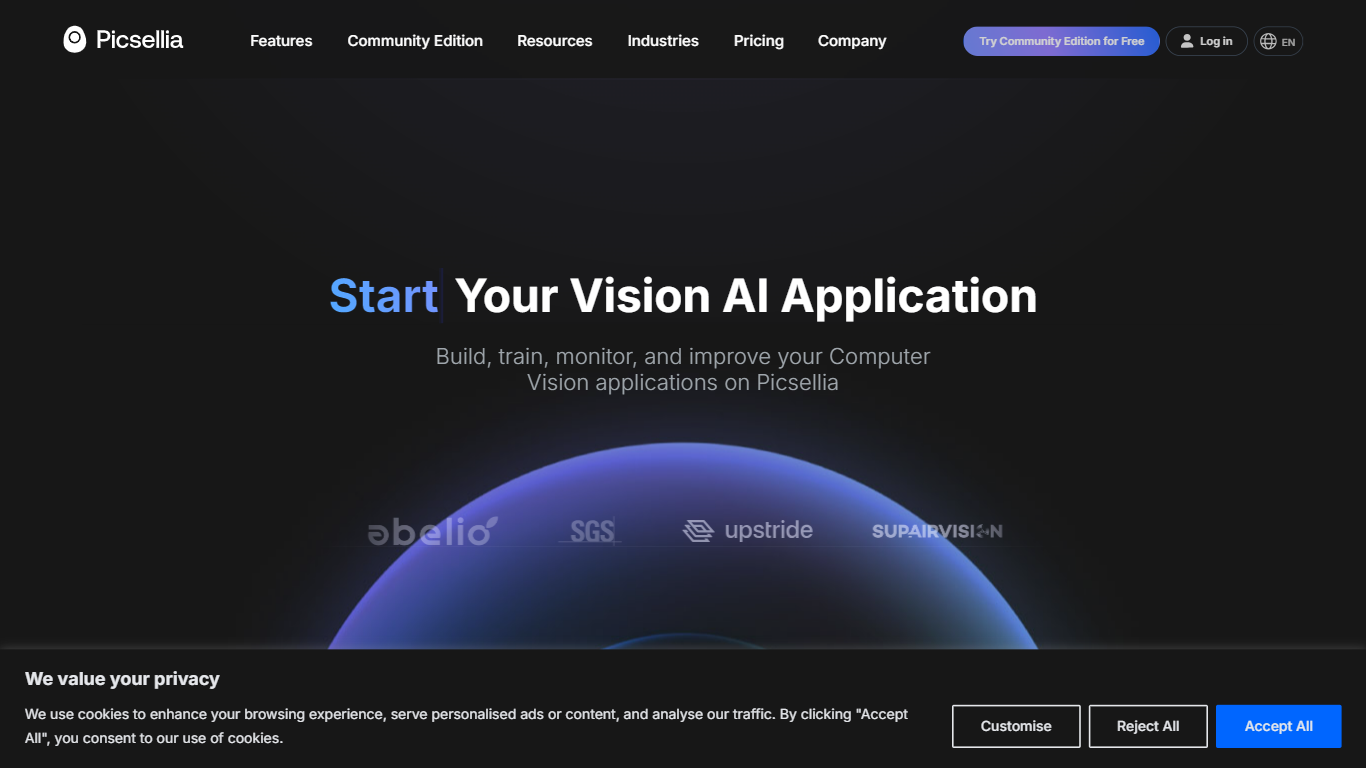
Picsellia gives computer vision teams one workspace from raw images to deployed models, covering data collection, annotation, training, deployment, and monitoring without stitching separate tools together. Manufacturing, agriculture, and energy teams use it for defect detection, crop monitoring, and infrastructure inspection at production scale.
Generic MLOps stacks treat images like any other dataset, which means awkward workarounds for labeling, similarity search, and detection metrics. Picsellia centers on visual data specifically: CLIP-powered similarity search, native annotation with AI assistance, and evaluation tuned for detection, segmentation, and classification. You can deploy on SaaS, on-premise, or hybrid, which matters when production cameras cannot send frames to a public cloud.
Data scientists and ML engineers get a Python SDK with type hints and async support, plus 50+ integrations with PyTorch, TensorFlow, S3, SageMaker, and MLflow. Operations teams get ISO 27001 certification, role-based access control, and a 99.9% uptime SLA. The platform reports 50M+ images processed, 10K+ models trained, and 1B+ predictions served across 200+ teams.
Modular pricing with Data Engine at €1,000/month and usage-based DPU billing from €0.80 per unit
14-day free trial with 10,000 image uploads and 100 GPU hours, no credit card required
Python SDK with type hints, async support, and Jupyter-ready display for programmatic access
50+ integrations including PyTorch, TensorFlow, S3, SageMaker, MLflow, and Weights & Biases
ISO 27001 certified with 99.9% uptime SLA and role-based access control
Deploy on cloud SaaS, on-premise, or hybrid configurations
Full computer vision lifecycle in one platform instead of stitching together separate annotation, training, and monitoring tools.
Modular pricing lets teams start with Data Engine and add training or monitoring modules as projects scale.
Python SDK with type hints and 50+ integrations fits existing PyTorch and MLflow workflows.
ISO 27001 certification and 99.9% uptime SLA suit enterprise production deployments.
VisionAI Factory and Reliability Engine modules require the Data Engine base at €1,000 per month.
Usage-based DPU and monitoring unit costs add up quickly at high image or prediction volumes.
Focused on computer vision only, not a fit for NLP or tabular ML workloads.
What is Picsellia?
Picsellia is an MLOps platform built for computer vision. It covers the full lifecycle from image management and annotation through model training, deployment, and monitoring in one workspace, so data scientists and operations teams share the same platform.
Does Picsellia offer a free trial?
Yes. Picsellia offers a 14-day free trial with full platform access and no credit card required. The trial includes 10,000 image uploads, 100 GPU hours for training, and access to all features.
How much does Picsellia cost?
Picsellia uses modular pricing. The Data Engine module starts at €1,000 per month, VisionAI Factory at €250 per month, and Reliability Engine at €500 per month. Usage-based costs apply for data processing units and monitoring units with volume discounts.
Who uses Picsellia?
Picsellia serves teams building computer vision applications in manufacturing, agriculture, energy, sports analytics, and document processing. Customers include SGS, RTE, and Pellenc, ranging from startups to enterprise teams managing billions of images.
How is Picsellia different from generic MLOps tools?
Picsellia is built specifically for visual data rather than tabular datasets. It includes native image and video handling, built-in annotation with AI assistance, CLIP-powered visual similarity search, and evaluation metrics tuned for detection, segmentation, and classification.
Can Picsellia run on-premise?
Yes. Picsellia supports cloud SaaS, on-premise installation, and hybrid deployments. Enterprise customers can run the platform where their data lives, with ISO 27001 certification and private cloud options available.