
Last updated 09-01-2026
Category:
Reviews:
Join thousands of AI enthusiasts in the World of AI!
QRev
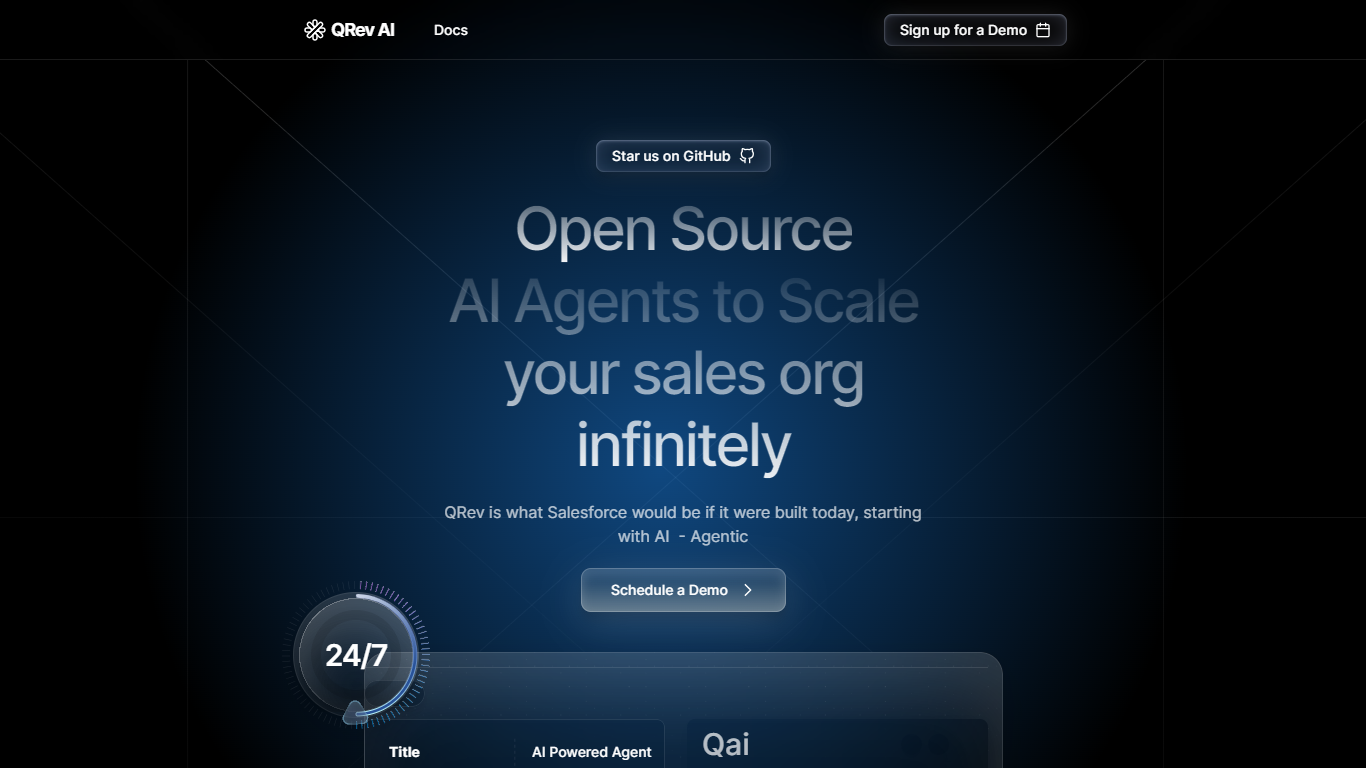
QRev lets revenue teams self-host AI agents that run prospecting, outbound email sequences, and CRM updates from one AGPL-3.0 codebase on GitHub. The project ships a React client, a Node.js app server, and a Python AI server so sales orgs can deploy the stack on their own infrastructure instead of renting a closed CRM.
Where Salesforce and HubSpot sell closed cloud CRMs, QRev bets on one superagent called Qai that coordinates research, multi-step email sequences, and CRM updates internally. The README describes role-based permissions shaping what Qai can do rather than naming a separate digital worker for every sales title.
Qai handles outbound work like ICP-based prospect research, personalized email drafting from CSV uploads, and QRM contact management. Integrations documented in the server README cover Google OAuth sign-in, Zoom, and HubSpot. The repo lists 361 stars, 71 forks, and 382 commits, with development still marked as an early community release.
AGPL-3.0 GitHub repo with 361 stars, 71 forks, and 382 commits as of this enrichment
Qai superagent runs prospect research, multi-step email sequences, and CRM updates from one chat workflow
Self-host three services: React client, Node.js 18.18+ app server, and Python AI server with MongoDB 5.x
ChromaDB vector store and Langchain power the AI server alongside SQLite or SQLAlchemy-compatible databases
Upload prospect CSVs using the bundled qai_csv_sample.csv column structure for campaign generation
Documented OAuth integrations for Google Gmail, Zoom, and HubSpot in the server README
AGPL-3.0 license lets teams inspect, fork, and extend the full sales agent stack.
Single Qai superagent covers prospecting, sequences, and CRM instead of juggling separate SDR tools.
Documented OAuth setup for Google Gmail, Zoom, and HubSpot in the server README.
Active GitHub development with 361 stars, open issues, and a community Slack invite linked from the README.
Self-hosting requires coordinating Node.js, MongoDB, and Python services across three codebases.
The qrev.ai marketing site returned HTTP 404 on live browser checks during this enrichment.
The project README still labels QRev as an early release aimed at technical contributors.
Is QRev open source?
Yes. QRev is published on GitHub under the AGPL-3.0 license at github.com/qrev-ai/qrev. You can clone the repository and run the React client, Node.js server, and Python AI server on your own infrastructure.
Can I self-host QRev?
Yes. QRev runs as three components documented in the GitHub README: a React client, a Node.js 18.18+ app server with MongoDB 5.x, and a Python AI server. Setup steps cover environment files, JWT secrets, and MongoDB configuration.
What does the Qai agent do in QRev?
Qai is QRev's sales superagent. It helps create campaign sequences, research prospects, draft personalized outreach emails, and manage contacts inside the built-in QRM CRM through the QAI bot APIs described in the server README.
Which integrations does QRev support?
QRev's server README documents Google OAuth sign-in with Gmail send and read scopes, Zoom user-managed OAuth apps, and HubSpot developer app credentials. SendGrid is optional for backend error reporting.
How do I import prospects into QRev?
In QRev, you upload a CSV of people to the Qai bot. The repository includes qai_csv_sample.csv showing the expected column structure, and the AI server generates personalized subjects and bodies for each prospect.
Where is QRev's documentation hosted?
The maintained install guide, architecture diagram, and integration docs live on the GitHub repository at github.com/qrev-ai/qrev. The qrev.ai marketing homepage returned a Framer 404 during live fetches, so GitHub is the reliable source for setup.