
Last updated 08-14-2026
Category:
Reviews:
Join thousands of AI enthusiasts in the World of AI!
AssemblyAI
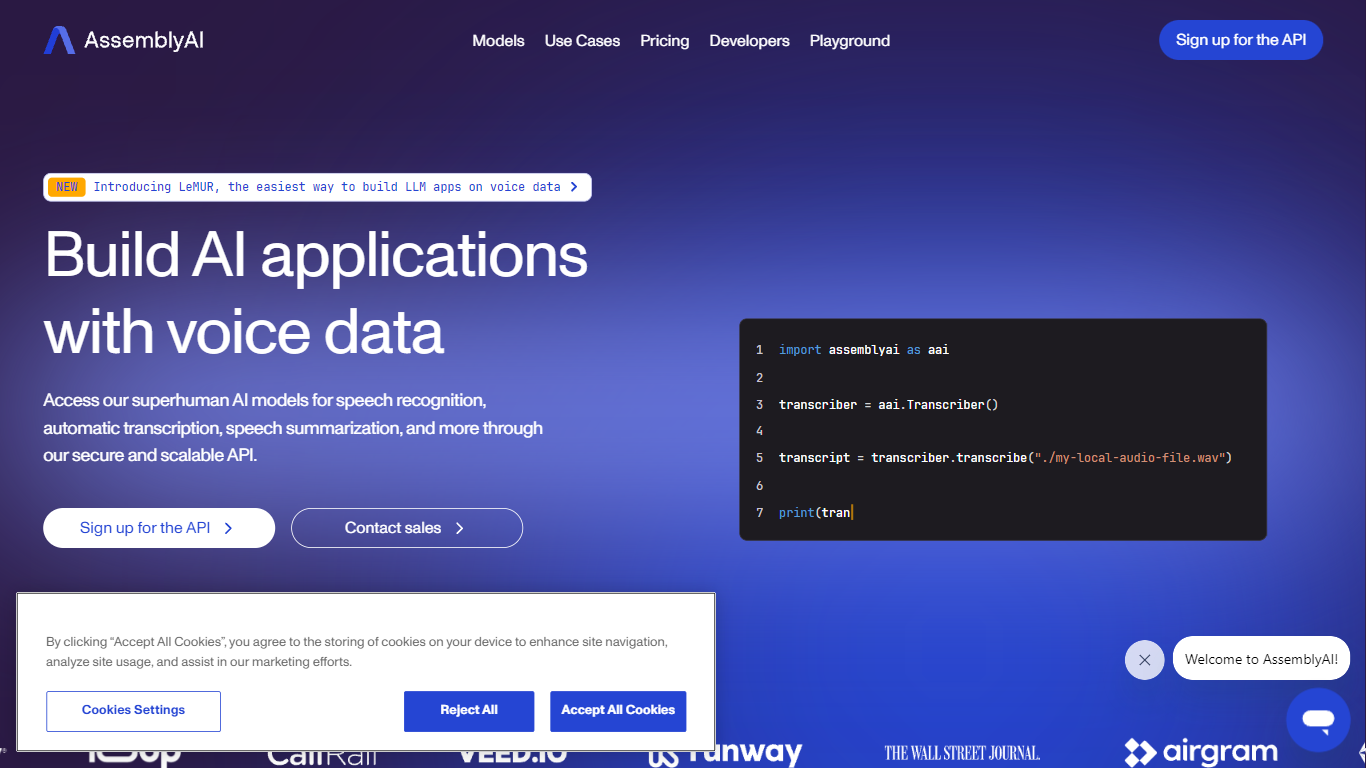
AssemblyAI gives developers APIs to transcribe, understand, and act on speech in production apps. The platform covers pre-recorded speech-to-text, real-time streaming transcription, a Voice Agent API over WebSocket, Speech Understanding add-ons, Guardrails, and an LLM Gateway for voice workflows. Teams wire it into call centers, voice agents, meeting tools, and media pipelines without hosting their own models.
General-purpose cloud speech APIs spread features across separate services. AssemblyAI stacks diarization, sentiment, entity detection, PII redaction, and topic tagging on the same transcription request with per-hour add-on pricing. That matters when you want speaker labels and moderation in one pass instead of chaining three vendors after the transcript lands.
Engineering teams building voice agents, compliance-heavy transcription, or multilingual products fit AssemblyAI best. Pricing is usage-based with $50 in free credits and no credit card required, but streaming bills per open WebSocket session rather than audio minutes alone. If you only need a simple one-off file transcript, a lighter consumer tool may be cheaper.
Universal-3.5 Pro async transcription is priced at $0.21 per hour of submitted audio
Real-time Universal-3.5 Pro streaming runs at $0.45 per hour of open WebSocket session time
Voice Agent API bills $4.50 per hour ($0.075 per minute) for speech-to-speech agents
Speech Understanding add-ons include diarization, sentiment, entity detection, and translation on one request
Platform reports 800M+ API calls processed monthly with coverage across 99 languages
Stacks Speech Understanding and Guardrails features on one transcription request instead of separate pipelines
Universal-3.5 Pro lists a 4.35% word error rate on the public features page
Signup includes $50 in free credits with no credit card required
EU region uses the same pricing as US with api.eu.assemblyai.com for data residency
Voice Agent API bundles STT, LLM, and TTS for $0.075 per minute on one WebSocket
Streaming bills per open WebSocket session duration, so idle connection time still counts
Add-on features stack on the base hourly rate and can raise costs quickly on complex requests
Developer-focused API surface is overkill for teams that only need a simple file upload UI
Some legacy features like Auto Chapters are deprecated and can error on Universal-3.5 Pro
What does AssemblyAI's API do?
AssemblyAI provides Voice AI infrastructure for developers to transcribe, understand, and act on speech. Core products include pre-recorded speech-to-text, real-time streaming transcription, Voice Agent API, Speech Understanding, Guardrails, and LLM Gateway.
How much does AssemblyAI Universal-3.5 Pro cost?
AssemblyAI prices Universal-3.5 Pro pre-recorded transcription at $0.21 per hour of audio submitted. The real-time Universal-3.5 Pro streaming model is $0.45 per hour based on WebSocket session duration.
Does AssemblyAI offer free credits?
Yes. AssemblyAI includes $50 in free credits with no credit card required on signup, according to its pricing reference. Pay-as-you-go usage continues after credits are consumed.
What is AssemblyAI Voice Agent API pricing?
AssemblyAI Voice Agent API costs $4.50 per hour, equal to $0.075 per minute, on a single WebSocket endpoint. That rate covers STT, LLM reasoning, TTS, turn detection, and tool calling in one bundled session price.
Which languages does AssemblyAI support?
AssemblyAI automatic language detection transcribes audio across 99 languages from one API, per its features page. Medical Mode and some add-ons list narrower language support on the pricing reference.
Can AssemblyAI redact PII from transcripts?
Yes. AssemblyAI Guardrails include PII text redaction and PII audio redaction add-ons priced at $0.08 and $0.05 per hour respectively. PII redaction can remove sensitive fields and bleep audio in one call.
Is AssemblyAI enterprise ready?
AssemblyAI advertises SOC 2 Type 2 and GDPR compliance with BAA availability, plus optional self-hosted deployment. Its features page cites sub-300ms latency for streaming and voice agents at scale.