
Last updated 08-03-2026
Category:
Reviews:
Join thousands of AI enthusiasts in the World of AI!
Gradio
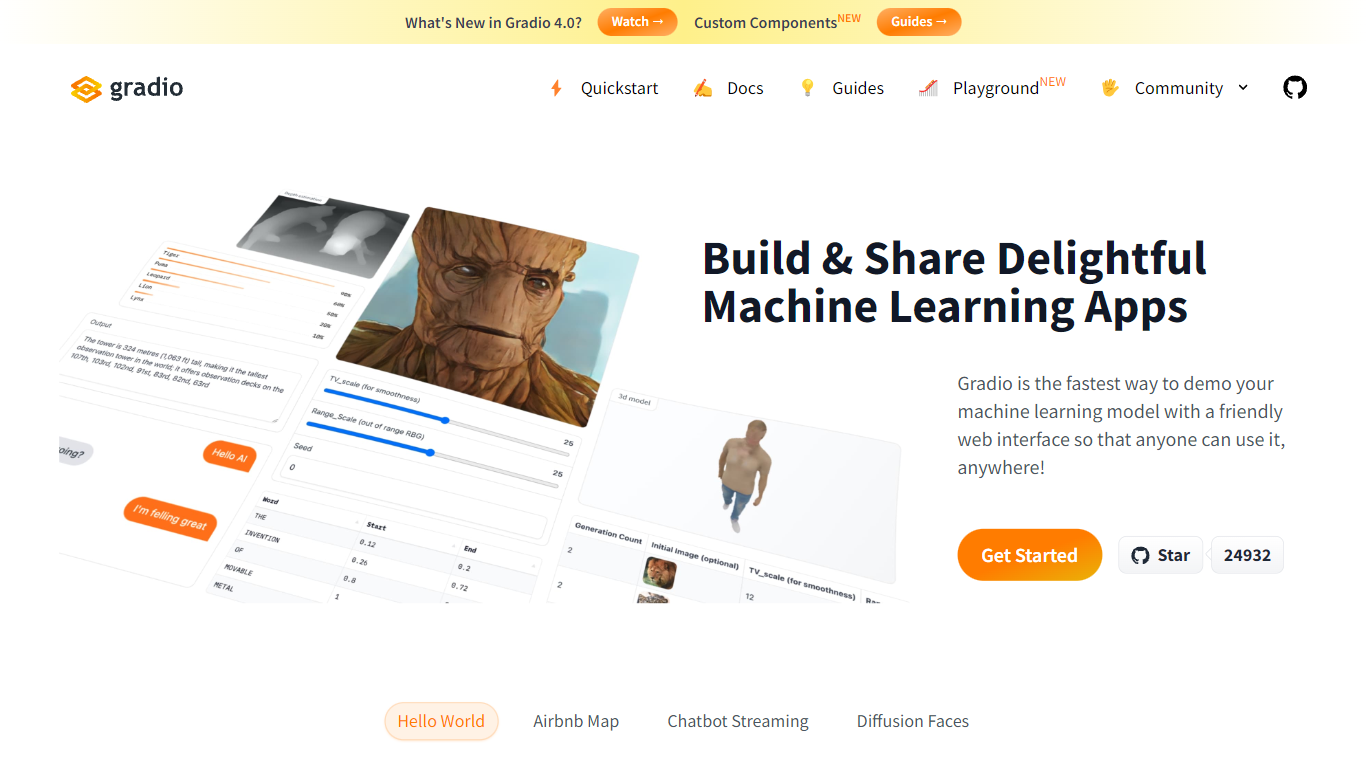
Gradio lets you wrap any Python function or ML model in a web demo with a few lines of code. This open-source Python library ships 40-plus UI components for images, audio, video, chat, dataframes, and JSON, then serves the interface locally or deploys it permanently to Hugging Face Spaces. Run pip install gradio, define your function, and call demo.launch() to get a browser UI at localhost:7860.
Streamlit and Dash also build Python web apps, but Gradio is built specifically for model demos: gr.Interface wraps a single prediction function, gr.ChatInterface handles chatbots, and gr.Blocks supports multi-step layouts like the Automatic1111 Stable Diffusion UI. The share=True flag creates a temporary public URL in seconds, which is hard to replicate without setting up your own hosting.
ML engineers, researchers, and hobbyists use Gradio to prototype interfaces before production. It requires Python 3.10 or higher, needs no JavaScript or CSS knowledge, and is free and open source with optional free hosting on Hugging Face Spaces.
Build a working demo with
gr.Interface(fn, inputs, outputs)in under 10 lines of Python40-plus built-in components for images, audio, video, 3D, chat, plots, and dataframes
Free permanent hosting on Hugging Face Spaces with auto-scaling and a shareable URL
demo.launch(share=True)creates a temporary public link like https://xxxxx.gradio.live in secondsGradio 6 adds MCP support, vibe mode for natural-language app editing, and hot reload via
gradio app.py43,000-plus GitHub stars with clients for querying any Gradio app from Python or JavaScript
Fastest path from a Python function to a shareable web demo, often under 10 lines of code.
No frontend skills required; handles JavaScript, CSS, and hosting complexity.
Free permanent deployment on Hugging Face Spaces with a large existing ecosystem.
Python-only for building UIs; not suited for teams that need a custom React frontend.
Complex multi-page apps require Blocks, which has a steeper learning curve than Interface.
Temporary share links depend on your local machine staying online.
Is Gradio free to use?
Yes, Gradio is free and open source under an Apache 2.0 license. You can install it with pip, run demos locally, and deploy permanently to Hugging Face Spaces at no cost. There is no paid tier on the Gradio library itself.
How do I install Gradio?
Gradio requires Python 3.10 or higher. Install it with `pip install --upgrade gradio` in a virtual environment. Run your app with `python app.py` or use `gradio app.py` for hot reload during development.
Can I share a Gradio demo without hosting?
Yes, pass `share=True` to `demo.launch()` and Gradio creates a temporary public URL like https://xxxxx.gradio.live. Anyone can access the demo while your local machine runs the model. For permanent hosting, deploy to Hugging Face Spaces.
What is the difference between Interface and Blocks in Gradio?
Gradio Interface is a high-level wrapper for single-function model demos with defined inputs and outputs. Blocks is a lower-level layout system for custom UIs with multiple data flows, conditional visibility, and complex interactions, used by apps like Automatic1111.
Does Gradio support chatbots?
Yes, Gradio includes `gr.ChatInterface`, a high-level class that creates a full chatbot UI from a single Python function. It handles message history, streaming, and layout without requiring custom frontend code.
Where can I host a Gradio app permanently?
Hugging Face Spaces is the most popular permanent hosting option for Gradio apps and is free. Spaces provides auto-scaling, a public URL, and integration with the Hugging Face model hub. Gradio also supports custom server deployment via `gradio.Server`.