
Last updated 07-27-2026
Category:
Reviews:
Join thousands of AI enthusiasts in the World of AI!
DeBERTa
DeBERTa enhances natural language understanding by using a disentangled attention mechanism that separately encodes word content and position. This allows the model to better capture relationships between words in a sentence, improving context comprehension.
What distinguishes DeBERTa is its ELECTRA-style pre-training combined with gradient-disentangled embedding sharing. This approach increases training efficiency and model performance, enabling smaller models to outperform larger ones on benchmarks such as MNLI and SQuAD v2.0.
DeBERTa offers a variety of pre-trained models ranging from 22 million to 1.5 billion parameters, including multilingual versions supporting over 100 languages. It supports integration with PyTorch, Docker, and pip, and provides scripts and documentation for pre-training and fine-tuning.
The tool has achieved state-of-the-art results on benchmarks like SuperGLUE, surpassing human performance with its large-scale models. Its balance of size, efficiency, and accuracy makes it suitable for both research and practical NLP applications.
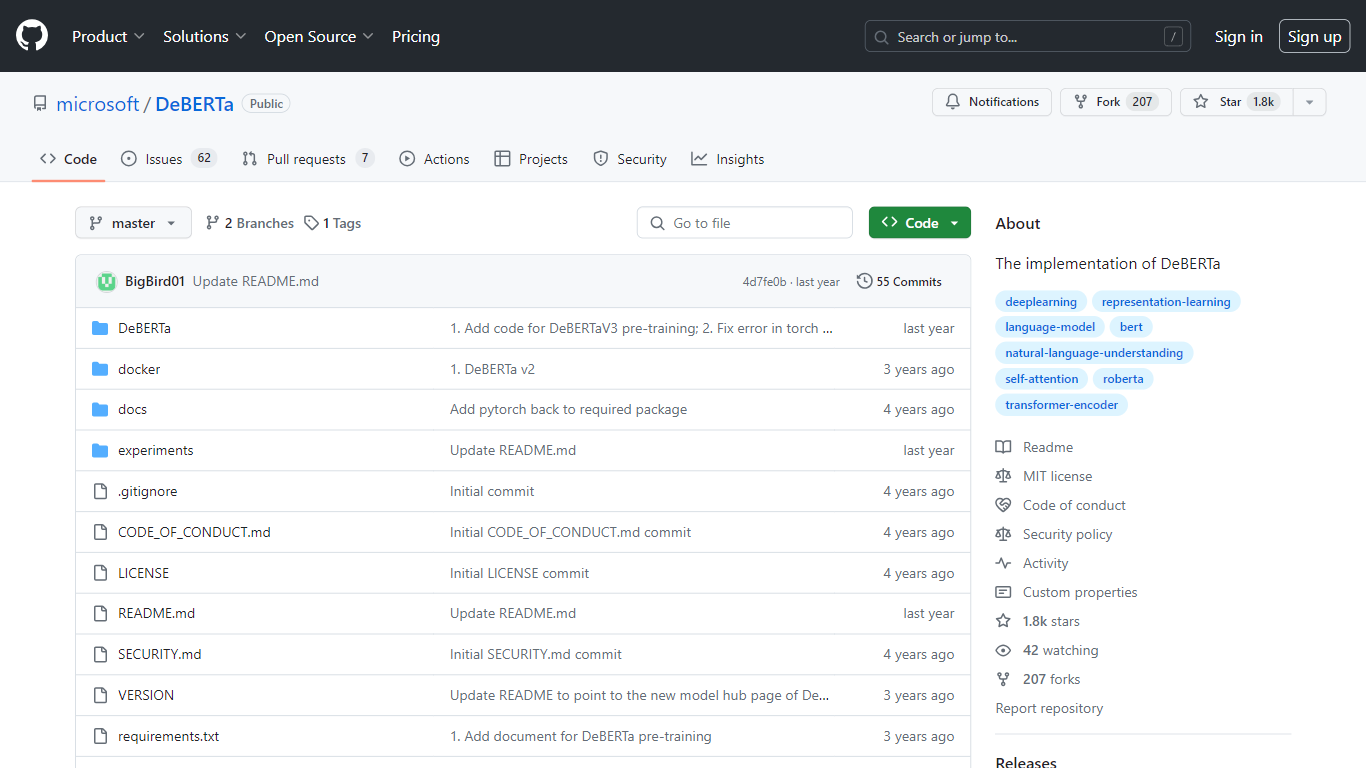
Maintained on GitHub by Microsoft researchers, DeBERTa encourages community contributions and offers support for collaboration and inquiries.
Disentangled attention separates word content and position for better context understanding 📚
ELECTRA-style pre-training boosts training efficiency and model accuracy ⚡
Wide range of pre-trained models from 22M to 1.5B parameters for flexible use 🧩
Multilingual support covering over 100 languages for global applications 🌍
Easy integration with PyTorch, Docker, and pip for quick deployment 🚀
Pre-trained models available on Hugging Face and GitHub releases
Detailed documentation and fine-tuning scripts included
Innovative attention mechanism improves language understanding accuracy
Efficient training methods reduce computational resources needed
Publicly available pre-trained models support diverse NLP tasks
Supports multiple languages including a large multilingual model
Comprehensive documentation and code examples facilitate adoption
Requires familiarity with PyTorch and machine learning frameworks
Large models demand significant GPU resources for training and inference
What is the main innovation in DeBERTa compared to BERT?
DeBERTa introduces disentangled attention that separately encodes word content and position, improving context understanding in DeBERTa.
How does DeBERTa V3 improve training efficiency?
DeBERTa V3 uses ELECTRA-style pre-training with gradient-disentangled embedding sharing to speed up training and enhance performance in DeBERTa.
Can I use DeBERTa models for languages other than English?
Yes, DeBERTa offers multilingual models supporting over 100 languages for cross-lingual tasks.
What frameworks are supported for using DeBERTa?
DeBERTa is implemented in PyTorch and can be used with Docker or installed via pip for easy integration.
Are pre-trained DeBERTa models available for download?
Yes, pre-trained DeBERTa models of various sizes are publicly available on Hugging Face and GitHub releases.
Does DeBERTa outperform other large language models?
DeBERTa V2 and V3 models have surpassed human performance on benchmarks like SuperGLUE and outperformed models like T5 11B, according to DeBERTa's evaluations.
Is there documentation to help fine-tune DeBERTa on custom tasks?
Yes, the DeBERTa GitHub repository includes detailed documentation and scripts for fine-tuning on common NLP benchmarks.