
Last updated 08-12-2026
Category:
Reviews:
Join thousands of AI enthusiasts in the World of AI!
Rapid Editor
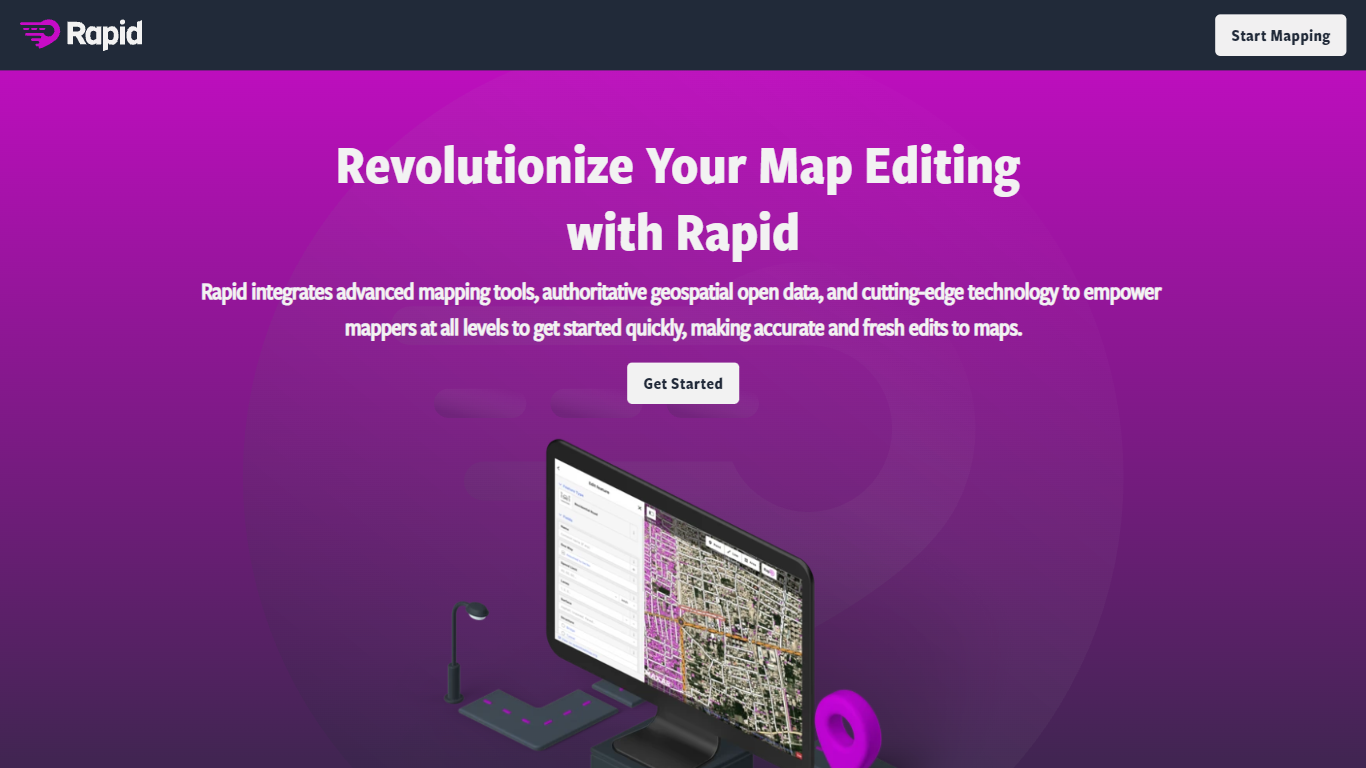
Rapid Editor lets you edit OpenStreetMap from the browser by reviewing satellite imagery, open geospatial datasets, and predicted roads, buildings, and pathways before you commit changes. You can browse the world map without signing up, but you need an OpenStreetMap account to save edits back to the community map. Meta built the editor to give new and experienced mappers a faster starting point than tracing every feature by hand.
Where classic OSM editors expect you to trace every road and building by hand, Rapid treats machine learning outputs as editable suggestions you accept, tweak, or ignore. That trade-off favors speed on humanitarian crises and large unmapped areas, not deep tag editing or offline workflows. The editor also lets you pull external map layers into the session, while predicted features ship under an MIT license with attribution rules for Maxar or DigitalGlobe imagery. If your workflow depends on JOSM plugins or painstaking manual geometry, Rapid will feel lighter and more opinionated.
Volunteer mappers, HOTOSM tasking managers, and local community groups use Rapid to chip away at missing roads and structures worldwide. Esri and OpenStreetMap partnerships surface authoritative datasets inside the same canvas, which helps teams standardize imports during coordinated mapathons. Humanitarian responders who need a quick visual scan of gaps before assigning tiles tend to reach for Rapid first, then hand complex fixes to other tools.
Predicted roads, pathways, and buildings appear as an editable overlay you accept, reject, or adjust before uploading to OpenStreetMap
Browse world map data without registering; an OpenStreetMap account is required only when you want to save edits back to the community database
Pull in external map layers as User-Originated Data, with you responsible for licensing and configuration per the site terms
Predicted feature datasets ship under the MIT license, with changeset attribution to source=maxar or source=digitalglobe when metadata requires it
Partnerships with OpenStreetMap, HOTOSM, and Esri surface authoritative open datasets inside the same editing canvas
Source code lives at github.com/facebookincubator/RapiD for community review and contributions
Free web app with no signup required to explore map data and predicted feature overlays
Accepts or rejects machine learning predicted roads and buildings instead of tracing every shape manually
Integrates OpenStreetMap, HOTOSM, and Esri datasets in one editing session
Open source codebase on GitHub for transparency and community contributions
Requires an OpenStreetMap account before you can publish edits back to the community map
Predicted features need careful review because accuracy depends on satellite imagery and may lag real-world changes
Browser-only editor with no offline workflow or JOSM-style plugin ecosystem
External data layers require you to handle licensing and configuration yourself
Is Rapid Editor free to use?
Yes. Rapid Editor is provided free of charge according to its terms of use on rapideditor.org. Meta may change or suspend access at its discretion, but there are no paid plans or subscriptions listed on the site.
Do I need an account for Rapid Editor?
You can view the world map and access certain Rapid Editor features without registering with Meta. To contribute mapping data to OpenStreetMap through Rapid Editor, you must open an account with OpenStreetMap and follow its registration process.
What does Rapid Editor use machine learning for?
Rapid Editor uses machine learning to identify predicted map features such as roads, pathways, and buildings from satellite imagery. These detections appear as an overlay you can review before deciding whether to add them to OpenStreetMap.
Who developed Rapid Editor?
Rapid Editor is developed by Meta Platforms, Inc. The rapideditor.org homepage credits Meta as the developer and lists OpenStreetMap as the powering project behind the editor.
What open data partners does Rapid Editor list?
Rapid Editor names OpenStreetMap, HOTOSM, and Esri as partners on its homepage. The editor is built to display open map data alongside machine learning detections inside the same mapping interface.
Where is Rapid Editor source code hosted?
Rapid Editor source code is published on GitHub at github.com/facebookincubator/RapiD. The site footer also links community repositories and support channels for mappers who want to inspect or contribute to the project.